Tuesday, November 5, 2013

Hiraizumi


On Sunday we accompanied the SICE group to Hiraizumi to get a glimpse of Heian Japan during the Autumn Fujiwara Festival. Hiraizumi was the home of the northern branch of the powerful Fujiwara clan for about 100 years in the late Heian era- beginning around 1100 AD. During that time, it served as a northern capital that rivaled Kyoto in size and splendor, at least until Yoritomo took out the Fujiwaras in 1189.
 
After taking the train down from Morioka, we walked to the temple garden of Mōtsū-ji. Like its neighbor Chūson-ji, Mōtsū-ji is said to have been established in 850. At its peak in the  twelfth century, Mōtsū-ji was reportedly home to more than 40 halls and pagodas, with more than 500 monks. Today, some of the buildings have been reconstructed, but the main focus of the site is the Heian era garden centered on a large pond. 


Catie helped us by "reading" all the signs. "This one has an 'a', 'n',..."


We took the Hiraizumi loop bus over to Chūson-ji and ate a quick lunch before heading up the large hill on which the temple complex is built. The path to the top is steep, but lined with lovely old japanese cedars (sugi- not really a cedar) with and understory of bamboo. As in Nikko, Chūson-ji has that wonderful Japanese feel of beautiful architecture hidden in a primeval forest. I'm sure the trees are not 1,000 years old like some of the buildings, but they give the place a very ancient atmosphere.


 There was also a chrysanthemum festival being celebrated on the temple grounds. They grow utterly huge chrysanthemums here! There were several sheds of flowers set up for judging. They also had some interesting chrysanthemum bonsai and a flower pagoda.


 On top, we visited an outdoor Noh theater performance. 
 
 Then went to the treasure hall to see many Heian relics and view the ornate Konjikidō (golden hall). The Konjikidō was completed in 1124 as a mausoleum for 3 rulers of the Fujiwara clan.

lightening fast Catie was trying to steal the Jizō's flowers

Hiraizumi's golden age lasted for nearly 100 years, but after the fall of the Fujiwaras the town sank back into relative obscurity and most of the buildings that gave the town its cultural prominence were destroyed. When the famous poet Basho saw the state of the town in 1689 he penned his famous haiku about the impermanence of human glory:


Natsu kusa ya                        

Tsuwamono-domo ga          

yume no ato                             


The summer’s grass
‘Tis all that’s left 
Of ancient warrior’s dreams.


 (this is a statue of Basho)


On the way back down we stopped at Chūson-ji itself. However, being a beautiful fall day in the middle of a 3-day weekend during the Fujiwara Festival, it was extremely crowded, so we did not stay very long.
 
 
Heading back down the hill and then home!


Saturday, November 2, 2013

Fall at Morioka Castle!

Tomorrow we have a long day trip planned with the SICE group, so we decided to stick around town today. We headed down to Iwate Park and the castle to see the foliage and give Catie a chance to play on the swings. The foliage was awesome! We were also happily surprised to find a festival happening in the park. We ended up spending most of the day playing around the castle grounds and enjoying the festival.

Morioka Castle
Taiko and a bounce house- something for everyone!!!
 

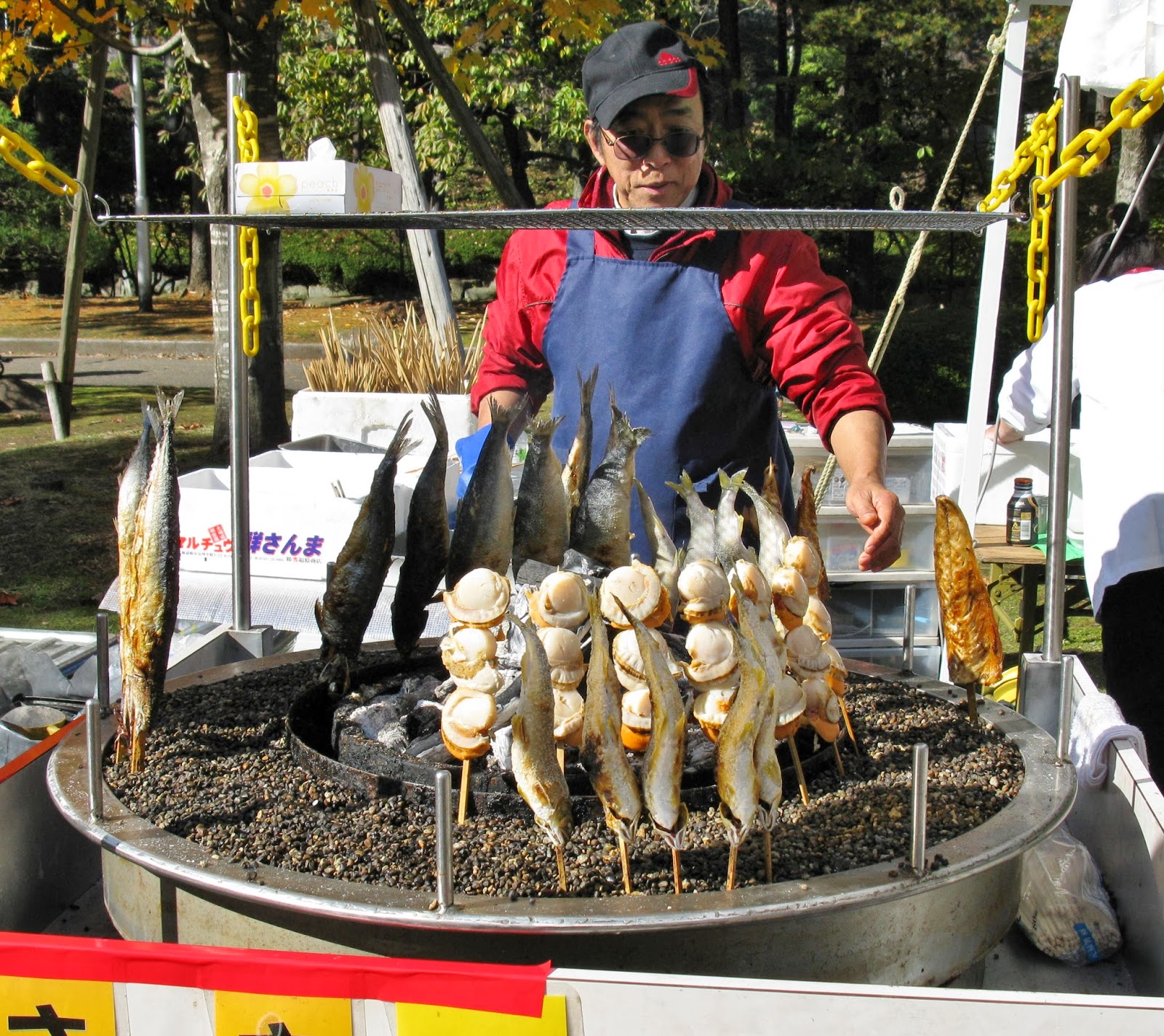
As always, there was a delicious array of festival food
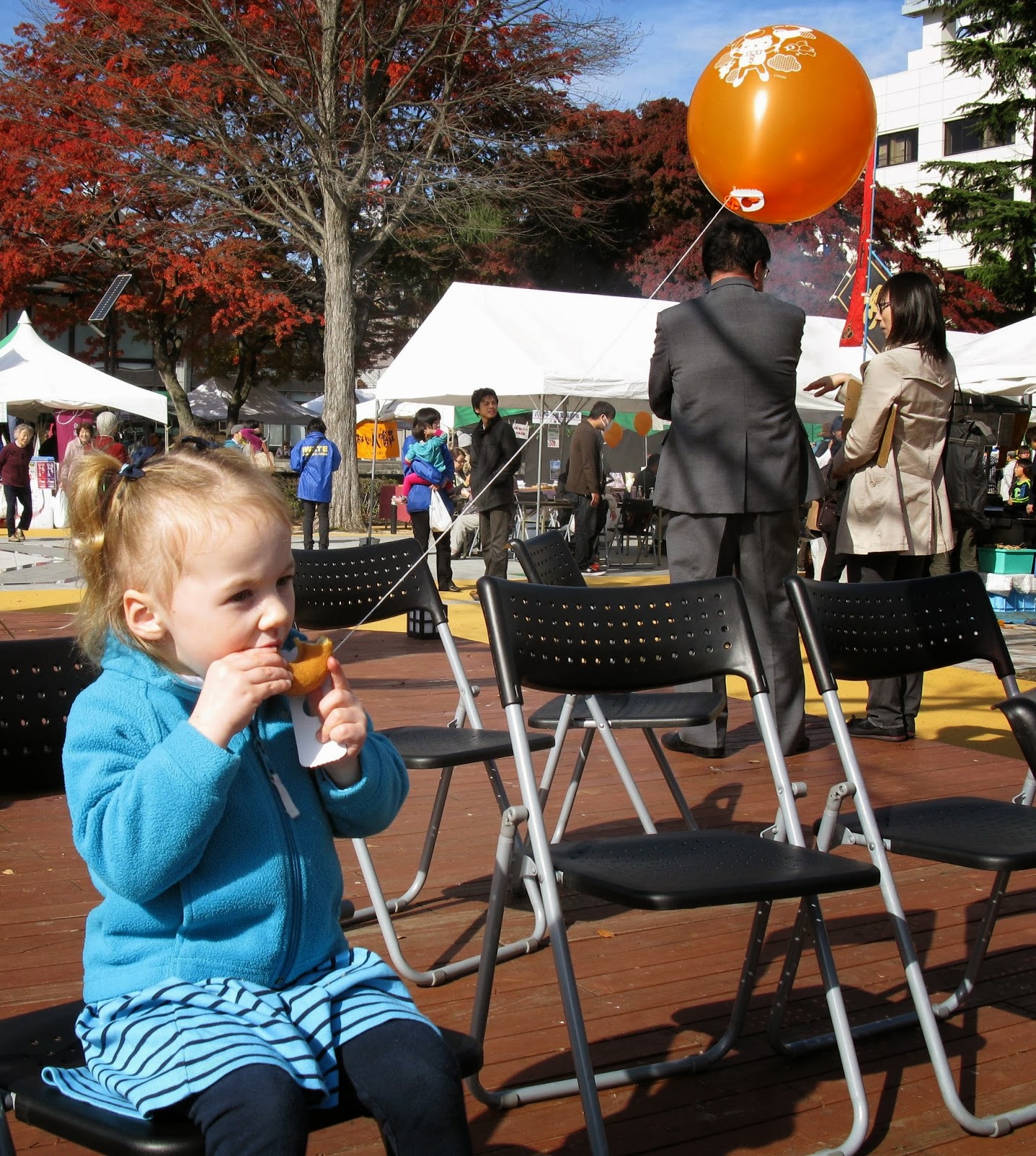
one of my favorites...custard-filled cakes. I'd never seen the panda shape before though!
You can get pretty much anything grilled on a stick- tofu, mochi, fish, scallops...
Not to be denied, Catie ate chocolate covered bananas in one hand and a custard panda cake in the other
and then a donut. (she also had some steak kebobs & roasted sweet potatoes)
We stopped in the museum to use the bathroom and Catie put on a happi coat and joined some other kids drumming on one of the Fall Festival Dashi


watch out, Catie!!!


Friday, November 1, 2013

Blue butts


Yesterday Catie was wearing some new pants with a waistband that was a little too large. As she was digging in the sand on the playground, they slipped down far enough that everyone could see her butt. I ran over, pulled up her pants, and all of the moms had a good laugh together. 

Today, one of the mothers who rarely talks to me, comes over and says “Catie has very white butt, do American children not have a blue butt?” I’m sure the look on my face was priceless. I had absolutely no clue what she was asking me! After a lengthy discussion that involved consulting a few other moms and eventually an I-phone, I finally understood. Most Japanese children are born with Mongolian Spots. The big blue patches eventually fade away- usually by age 3 or 4, but sometimes not until puberty. I get the impression that having a blue butt is considered lucky. Just to make sure I understood, a couple of the moms rounded up their toddlers, pulled down their pants, and showed me the kids’ blue butts! They really are BLUE! It was without a doubt the oddest playground conversation I’ve ever had. Gotta love Japan!!!

I was also at FIK earlier in the day to assist with the sweet potato roast. Another mom and I helped the kids wrap their potatoes in wet newspaper and then in tin foil. The principal then roasted all the foil-wrapped potatoes over a charcoal fire. YUMMY! While the potatoes were roasting, the kids sang a song in English (Mr. Sun) and a cute song about roasted sweet potatoes (yaki imo) in Japanese to thank the parent helpers. Here are short videos of the class singing to us … (Catie is 2nd from the right)